|
What we doThe Communities, Forests, and Fire Research Group at the Northern Arizona University School of Forestry work together to explore how communities experience wildfire and forest management in the U.S. Southwest and beyond. We focus on applying social science research methods to produce robust research and management and policy recommendations.
|
Research Group Members
Graduate Researchers
|
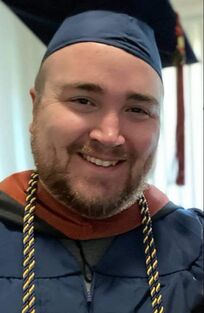
Jack Burnett, Ph.D. Candidate
I received my bachelor’s degree in anthropology from Tulane University in 2012 with a focus in cultural anthropology. After three years teaching English in Japan and a few years working in the insurance industry, I decided to pursue a graduate degree to deepen my knowledge and better understand how to improve the relationship between society and nature. I graduated from NAU with a Master of Forestry degree in spring 2020. For my master’s project, I partnered with a local elementary school to design, implement, and evaluate an environmental education program called Forest Fridays. I started my Ph.D. in Forest Science in the summer of 2020 with a focus on wildfire social science. My dissertation research addresses the state of collective action towards wildfire in the Southwest and finding ways to improve this critical tool in the pursuit of building fire adapted communities. I hope to use this research to develop better wildfire management techniques and promote safer relationships between people and fire. Jack's research is funded by the US Department of Agriculture via McIntire Stennis appropriations. Jack's most recent lead author publications: |
|
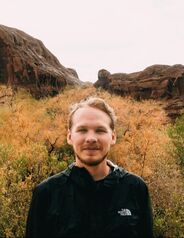
Will Cannon, Ph.D. Student
I received my bachelor's degree from the University of Utah in 2020 from the Geography department, with a climate change emphasis. Upon graduating, I decided I wanted to develop a better understanding of climate change impacts and efforts to mitigate them — which led me to study wildfire using social science methodology for my Master's thesis. I graduated from NAU with a Master of Geography in the Summer of 2022. My Master's project investigated community and professional perspectives of localized wildfire and associated environmental changes, with the ultimate goal of identifying how different groups' power, values, and general positionality influenced wildfire adaptation preferences. Having enjoyed the research process I discovered in my Master's, I began pursuing a Ph.D. in the School of Forestry in the Summer of 2022. I am currently investigating public and professional wildfire knowledge as well as evacuation decision-making utilizing models provided by the National Center for Atmospheric Research as part of their Innovator program. I look forward to continuing to develop my research skillset and creating research that aids wildfire and climate change adaptation efforts. Will's research is funded by the National Center for Atmospheric Research and the Joint Fire Science Program. |
|
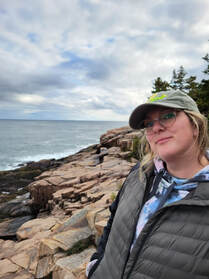
Cara Caruolo, Ph.D. Student
I received my bachelors degree in anthropology and sociology from the University of North Carolina at Greensboro in 2017 with a concentration in criminology. In October of 2018, I moved to Chico, CA and was working in Paradise, where the Camp Fire started on November 8, 2018. Shortly after the fire I moved to Colorado and began a graduate degree at the University of North Texas. In August of 2022 I graduated with an MS in Applied Anthropology. My research was done with a local fire district in Colorado Springs, CO looking a wildfire mitigation and risk perceptions in two WUI neighborhoods. In August of 2022, I began my Ph.D. in Forest Science at NAU. My research is centered around creating a database for wildfire-affected communities in the Western US to view grants available to them during the recovery process. Cara's research is funded by the Arizona Board of Regents' Technology and Research Initiative Fund and the Joint Fire Science Program. |
|
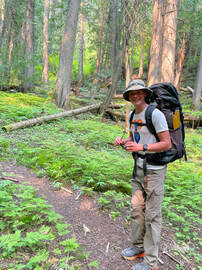
Wills DeGrandpre, M.S. Student
I am a first-year graduate student at Northern Arizona University. I was born and raised in Northwestern Montana, and in 2019 I moved to Flagstaff to attend NAU. In 2023 I graduated with a B.S. of Forestry. Through this experience I fell in love with Flagstaff and the School of Forestry, and narrowed my academic interests. I have always been fascinated by wildfire, and community-wildfire interaction is a field that I am excited to help advance! I am now pursuing a M.S. degree, focused on perceptions of ignition sources and fire history in Southwestern U.S. communities. Outside of school I enjoy trail running, backpacking, canyoneering, mountain biking, and various other outdoor pursuits. Wills' research is funded by the Joint Fire Science Program. |

|
Sarah Devenport, M.S. student
I am currently a second year M.S. student at the School of Forestry. My research focuses on human-caused ignitions of wildfire though the scope of recreation on public lands. Prior to starting graduate school, I worked on a pre-sale timber preparation crew with the U.S. Forest Service. I attribute much of my interest in the social aspects of wildfire and prevention strategies to experiences I had while working on public lands. Sarah's research is funded by the Joint Fire Science Program. Sarah's most recent work includes a series of factsheets on surveys about visitor perceptions of human-caused ignitions across the Coconino, Santa Fe, and Carson National Forests. |
Undergraduate Researchers
|
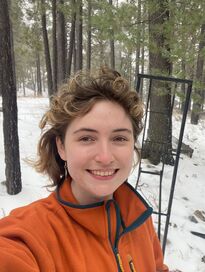
Helena Moomjian, Interns2Scholars Researcher
I am a second year undergraduate pursuing a degree in Geography with minors in GIS and Physical Geography. I am particularly interested in GIS applications in forestry. I’ve participated in field data collection and entry for graduate research, and this semester I will be focusing on academic writing and data synthesis. Helena's research is funded by NAU's Interns2Scholars program. Read about Helena's research in a recent NAU news article. |

|
Zoë Zamudio, Undergraduate Research Assistant
I am in my fourth year as an undergrad at NAU, pursuing a BS in Forestry with a certificate in Human Dimensions and a minor in Chinese. With the help of service dogs Ziva and Zadie, I’ve had the pleasure of assisting some of the graduate students in their research, with a big contribution to helping gather data regarding human ignited wildfires. Zoë's research is funded by the Joint Fire Science Program and the National Institutes of Health. |
Alumni
|
Scott Franz, M.S. Student, 2021-2023.
Then: Scott was a 2023 JFSP Graduate Research Innovation (GRIN) award recipient and NAU's 2023 Outstanding Masters-level Graduate Research Assistant. Now: Research Assistant on the ReShape project for the Southwest Ecological Restoration Institutes. Margaret Sichrovsky, Undergraduate Research Assistant, 2020-21.
Now: Public Affairs Specialist for the US Forest Service on the Nez Perce-Clearwater National Forest, ID. Astrid Alder, Interns2Scholars researcher, 2020 - 2021.
Now: MSc student at Vrije Universiteit Amsterdam. McKenna Hedgepeth, M.S. Forestry, 2019 - 2020.
Now: Staff at the New Mexico Environment Department Air Quality Bureau. Max Benning, Undergraduate Research Assistant, 2020.
Now: M.S. student at the University of Minnesota. |
Hayden Jorde, M.F. Student, 2021-2023. '
Now: Resource Assistant for the US Forest Service Pacific Northwest Research Station. Noah Haarmann, M.S. Student, 2021 - 2023
Then: Noah was a 2022 JFSP Graduate Research Innovation (GRIN) award recipient and a 2023 Presidential Management Fellow. Now: Smokejumper for the US Forest Service based out of Missoula, MT. Solena Daniels, Undergraduate Research Assistant, 2020 - 2021.
Now: Wildlife Biologist for the US Forest Service on the Kaibab National Forest, AZ. Megan King, Undergraduate Research Assistant, 2020.
Now: Forestry Technician with Arizona Department of Forestry and Fire Management |
